Read the following text. You may need a dictionary. By all means, use it!
Then solve the reading comprehension test below the text you have just read.
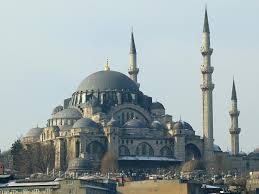
 Ravenna, the successor to Rome as imperial capital in Italy and then, as the so-called exarchate, the beach-head of Byzantium in the Germanized West, finally passed from Byzantine control. The images of Justinian and Theodora in San Vitale, proclaiming that the empire was still whole, were powerless to make it so. But the East remained firmly in the hands of successions of emperors for a thousand years; Constantinople became the magnificent citadel of the Byzantine civilization, and its influence streamed to all points of the compass. At the same time that the imperial presence in Ravenna was being symbolized in architecture and art, the vast church of Santa Sophia, or more properly Hagia Sophia, Church of the Holy Wisdom, was being built for Justinian in Constantinople by the architects Arthemius of Tralles and Isidorus from Milletus. Even today, this church (built between 532 and 537) remains one of the supreme achievements in the history of world architecture. Its dimensions alone are formidable for any structure not made of steel. In plan it is about 270 feet long and 240 feet wide; the dome is 108 feet in diameter and its crown rises some 180 feet above the pavement. In exterior view, the great dome dominates the structure, but the external aspect of the building are much changed from the original appearance. Huge buttresses were added to the original design and four towering Turkish minarets were constructed after the Ottoman conquest of 1453, when Hagia Sophia became an Islamic mosque. The building has been secularized in the 20th century and is now a museum.
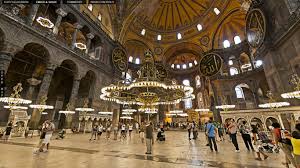
 The characteristic Byzantine plainness and unpretentiousness of the exterior (which, in this case, also disguise the great scale) scarcely prepare us for the interior of the building. The huge narthex, with its many entrances, leads into the centre of the structure, over which the soaring, canopy-like dome rides on a halo of light provided by the windows in the dome’s base. The impression made on the people of the time, an impression not lost on us, is carried in the words of the poet Paulus, an usher at the court of Justinian:
About the centre of the church, by the eastern and western half-circles, stand four mighty piers of stone, and from them spring great arches like the bow of Iris, four in all; and, as they rise slowly in the air, each separates from the other […] and the spaces between them are filled with wondrous skill, for curved walls touch the arches on either side and spread over until they unite above them […] The base of the dome is strongly fixed upon the great arches […] while above, the dome covers the church like the radiant heavens. Who shall describe the fields of marble gathered on the pavement and the lofty walls of the church? Fresh green from Carystus and many coloured Phryngian stone of rose and white, or deep red and silver; porphiry powdered with bright spots; emerald green from Sparta, and Iassian marble with waving veins of blood-red white; streaked red stone from Lydia, and crocus-coloured marble from the hills of the Moors, and Celtic stone, like milk poured out on glittering black, the precious onyx, like as if gold were shining through it, and the fresh green from the lnad of Atrax, in mingled contrast of shining surfaces.
 The dome rests on four pendentives. In pendentive construction which apparently was developed after many years of experiment by builders in the Near East and constitutes the contribution of Byzantium to architectural engineering, a dome rests on what is, in effect, a second, larger dome. The top portion and the four segments around the rim of the larger dome have been omitted and the four segments form four arches., the planes of which bound a square. By transferring the weight to the piers, rather than to the wall itself, pendentive construction makes possible a lofty, unobstructed interior space, as is particularly evident in Hagia Sophia.
 Structurally, although Hagia Sophia may seem Roman in its great scale and majesty, it does not have Roman organization of the masses. The very fact that what appears to be wall in Hagia Sophia is actually a concealed (and barely adequate) pier indicates that Roman monumentality was sought as an effect, and not directly taken from Roman building principles.
 Visitors to Hagia Sophia have been struck by the quality of light within the church and the effect it has on the human spirit. The forty windows at the base of the dome create the peculiar illusion that the dome is resting on the light that floods through them; an observer of that time thought that it looked as if the dome were suspended by a “gold chain from Heaven”. Procopius, the historian of the age of Justinian, wrote: “The vaulting is covered over with many little squares of gold, from which the rays stream down and strike the eyes so that man can scarcely bear to look.” Thus, we have a vastness of space shot through with light and a central dome that appears to be supported by the light it admits. Light is the mystic element—light that glitters in the mosaics, that shines forth from the marbles, and that pervades and defines spaces that, in themselves, seem to escape definition. Light becomes the agent that seems to dissolve material substance and transform it into an abstract, spiritual vision.
At Hagia Sophia, the intricate logic of Greek theology, the ambitious scale of Rome, the vaulting tradition of the Near East, and the mysticism of Eastern Christianity combine to create a monument that is at once a summation of antiquity and a positive assertion of the triumph of Christian faith.
from Horst de la Croix: Gardner’s “Art Through the Ages”, Univ. of Michigan, Ann Arbour, HBJ Harcourt
Correct the mistakes in the following sentences in accordance with the content of the text:
- Constantinople was the most important city of the Turkish Empire.
- The name of Hagia Sophia can be translated as ‘The Church of the Holy Ghost’.
- The church was built for the emperor Constantine.
- After the Turkish conquest of Byzantium, a new dome was added to the church.
- The materials used for its interior decoration were mainly wood and glass.
- The dome of the church rests on three pendentives.
- The pendentive construction is a dynamic solution to the problem of setting a round dome over a round space.
- The most striking characteristic of the church's interior is the sound quality.
- The two windows at its base create the illusion that the dome is resting on a halo of light.
e.g.1: the illusion the allusion,
or, e.g. 2: the illusion/the allusion
Deadline: January 9
ReplyDeleteConstantinople was actually the most important city of the Byzantine Empire, not the Turkish Empire. It only became part of the Ottoman Empire much later, in 1453.
The name Hagia Sophia translates as The Church of the Holy Wisdom, not the Holy Ghost.
The church was built for the emperor Justinian, not for Constantine.
After the Turkish conquest, the main additions were four tall minarets. A new dome was not added; the original dome remained, although the building was reinforced on the outside.
The materials used for the interior decoration were mostly precious marbles and richly coloured stones, not wood and glass. The text even lists specific types of marble coming from many regions.
The dome of the church rests on four pendentives, not three.
Pendentive construction is a solution for placing a round dome over a square space, not a round one. It shifts the weight onto piers instead of walls.
The most striking characteristic of the church’s interior is the quality of light, not the sound. Visitors were especially impressed by how the light seems to dissolve the material structure.
The forty windows at the base of the dome, not two, create the illusion that the dome is resting on a halo of light.
Devder Gabriela, Modă – Design Vestimentar
ReplyDelete1. Constantinople was the most important city of the Byzantine Empire, not the Turkish Empire.
2. The name of Hagia Sophia can be translated as “The Church of the Holy Wisdom”, not “The Church of the Holy Ghost.”
3. The church was built for the emperor Justinian, not Constantine.
4. After the Turkish conquest of Byzantium, the original dome remained, a new dome was not added, but four minarets were added to the church.
5. The materials used for its interior decoration were mainly marble and stone, not wood and glass.
6. The dome of the church rests on four pendentives, not three pendentives.
7. The pendentive construction is a dynamic solution to the problem of setting a round dome over a square space, not a round dome over a round space.
8. The most striking characteristic of the church’s interior is the quality of light, not the sound quality.
9. The forty windows, not two windows, at its base create the illusion that the dome is resting on a halo of light.
Szekely Adelina Maria (Graphics)
ReplyDelete1.Constantinople was the most important city of the Byzantine Empire.
2.The name of Hagia Sophia can be translated as “The Church of the Holy Wisdom.”
3.The church was built for the emperor Justinian.
4.After the Turkish conquest of Byzantium, four minarets were added to the church.
5.The materials used for its interior decoration were mainly marble and mosaics.
6.The dome of the church rests on four pendentives.
7.The pendentive construction is a solution to the problem of setting a round dome over a square space.
8.The most striking characteristic of the church’s interior is the quality and effect of light.
9.The forty windows at its base create the illusion that the dome is resting on a halo of light.
Iagar Lorena Sculputura
ReplyDeleteConstantinople was the most important city of the Byzantine Empire.
The name of Hagia Sophia can be translated as "The Church of the Holy Wisdom".
The church was built for the emperor Justinian.
After the Turkish conquest of Byzantium, four new minrates were added.
The materials used for its interior decoration were mainly precious marble and colored stones.
The dome of the church rests on four pendentives.
The pendentive construction is a dynamic solution to the problem of setting a round dome over a square space.
The most striking characteristic of the church's interior is the quality of light.
The forty windows at its base create the illusion that the dome is resting on a halo of light.
1.Constantinople was the most important city of the Byzantine Empire.
ReplyDelete2.The name of Hagia Sophia can be translated as ‘The Church of the Holy Wisdom’.
3.The church was built for the emperor Justinian.
4.After the Turkish conquest of Byzantium, four tall minarets were added to the church.
5.The materials used for the interior decoration were mostly marble and gold mosaics.
6.The dome of the church rests on four pendentives.
7.The pendentive construction is a solution for putting a round dome over a square space.
8.The most striking thing about the church’s interior is the way the light fills it.
9.The forty windows at the base of the dome make it look like the dome is resting on a halo of light.
1. Constantinople was the most important city of the Turkish/Byzantine Empire.
ReplyDelete2. The name of Hagia Sophia can be translated as “The Church of the Holy Ghost/Holy Wisdom”.
3. The church was built for the emperor Constantine/Justinian.
4. After the Turkish conquest of Byzantium, a new dome/four minarets were added to the church.
5. The materials used for its interior decoration were mainly wood and glass/marble, stone, and mosaics.
6. The dome of the church rests on three/four pendentives.
7. The pendentive construction is a dynamic solution to the problem of setting a round dome over a round/square space.
8. The most striking characteristic of the church’s interior is the sound quality/quality of light.
9. The two/forty windows at its base create the illusion that the dome is resting on a halo of light.